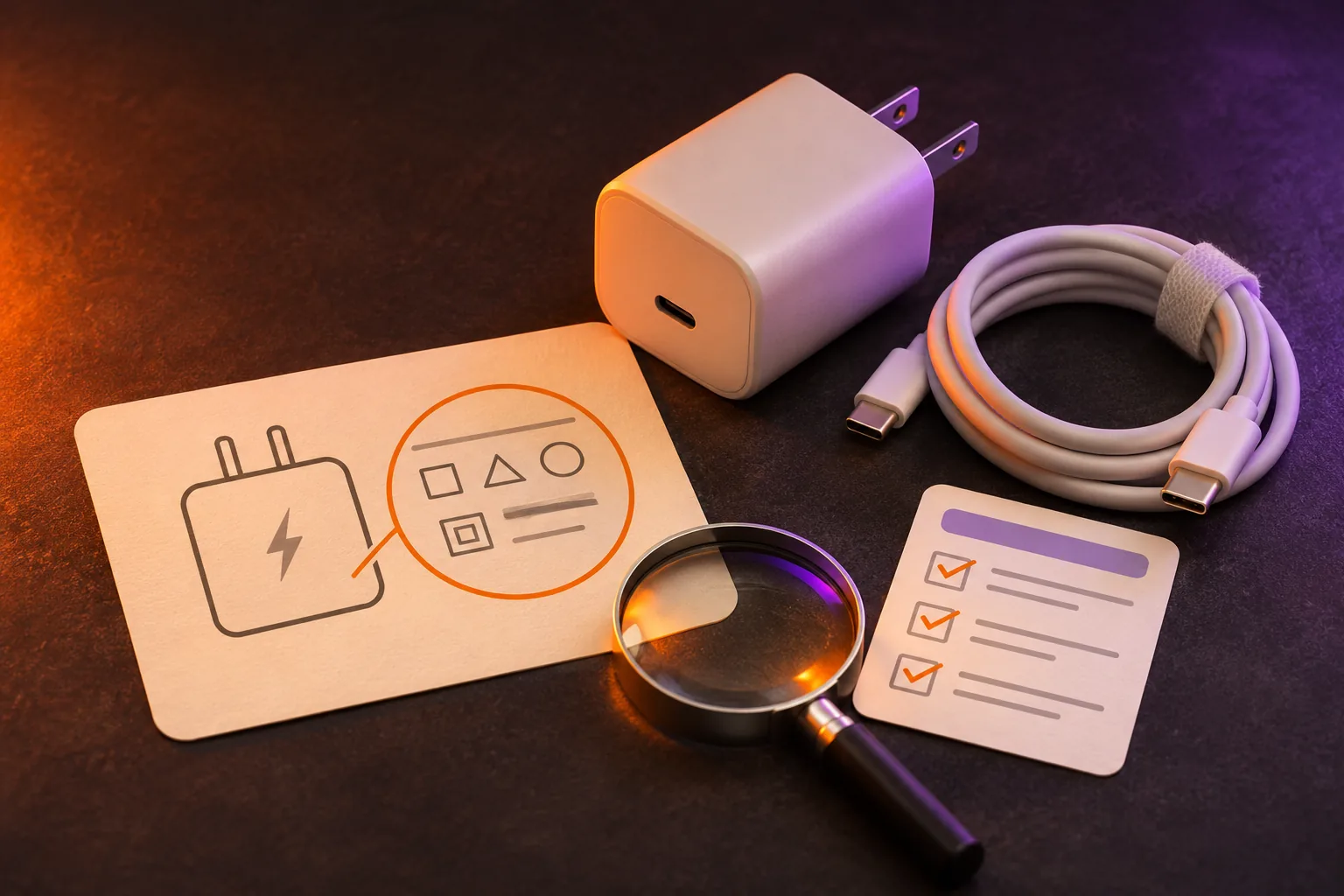
A printed logo is not the whole story
On May 6, 2026, the U.S. Consumer Product Safety Commission announced a national initiative focused on counterfeit certification marks and fake safety labels. The agency said it was seeking information about how false marks appear in online and retail channels and how regulators could strengthen enforcement. That announcement did not make every unfamiliar charger suspicious. It did underline a useful consumer habit: read the product label, then verify the record behind it. [1]
Certification marks are compact. They cannot fit the laboratory, standard, model scope and geographic coverage onto one tiny adapter. The logo is best treated as a pointer to those details, not as the details themselves.
What a U.S. safety certification mark can establish
OSHA’s Nationally Recognized Testing Laboratory program recognizes private organizations that can test and certify products to applicable safety standards within a defined scope. Proper certification generally means the product bears the laboratory’s registered mark, the product is covered by an appropriate test standard within that laboratory’s recognized scope, and the certification came from a recognized testing site. OSHA also makes clear that recognition of a laboratory is not a government endorsement of every product it certifies. [2]
There is no single universal “NRTL” logo. Each recognized laboratory uses its own mark. OSHA’s current list includes UL LLC, Intertek Testing Services, CSA Group and other organizations. The lab name can differ while the underlying system—testing to an applicable standard plus authorization to use the mark—remains the same. [3]
UL and ETL are different labs, not different safety grades
Consumers sometimes read ETL as a lesser version of UL. OSHA says it does not prefer one recognized lab over another when both are recognized for the same product-safety standard. Intertek describes the ETL Listed Mark as independent certification to applicable standards, while UL controls its own marks and certification schemes. The useful comparison is therefore not “Which logo looks more familiar?” It is “Does this exact product have a valid listing for its intended use?” [2][4][5]
CE is a different kind of mark
CE marking belongs to the European Union’s product-compliance system. The European Commission explains that the manufacturer is responsible for meeting the applicable EU requirements, preparing technical documentation and signing an EU declaration of conformity. Some product rules allow self-assessment; higher-risk categories may require an authorized notified body. There is no single central EU office that simply issues every CE mark. [6]
For a shopper in Texas, a CE logo should not be read as a substitute for a U.S. NRTL certification. OSHA’s FAQ specifically says CE marking is separate from U.S. NRTL requirements. A product can legitimately bear both kinds of marks because they answer different regulatory questions for different markets.
A component mark is not a listing for the finished product
The stylized UL Recognized Component Mark is meant for a component or subassembly that will be built into a larger certified product. UL explains that the component is evaluated under specific conditions—such as an enclosure, wiring method or temperature limit. That recognition can help a manufacturer certify the finished design, but it is not certification of a complete standalone charger or device. [7]
How to verify a mark in under two minutes
- Start on the product itself. Find the certifier’s mark, model number, manufacturer or brand, and any file, control or issue number. A logo that appears only in an online listing or on packaging deserves a closer look.
- Use the certifier’s directory. Search UL Product iQ for a UL mark or Intertek’s ETL Listed Mark Directory for an ETL mark. Match the company, model family, product category and geographic coverage—not just one similar word.
- Compare the record to the object. A record for a component, a different wattage or a different manufacturer does not confirm the product in your hand.
- Treat mismatches as unresolved. UL lists missing identifiers, altered artwork, spelling errors, poor print quality and marks shown only in marketing as warning signs. Visual inspection alone cannot prove authorization, so use the reporting channel when a mark still looks suspicious. [8]
Intertek’s public directory likewise lets users check products that bear an ETL Listed Mark. The directory record is the bridge between the small label and the certification claim. [9]
What a certification mark does not promise
A valid mark supports conformity to the applicable requirements in the certification’s scope. It does not promise that a product is the fastest, most durable, best value or compatible with every device. It also does not cover damage, counterfeit substitutions, unauthorized changes or use outside the listed conditions. Charger compatibility still depends on connector type, voltage, current, power profile and the device manufacturer’s instructions.
The best reading is specific: this identified product was certified by this organization to these requirements for this use and market. Anything broader should be checked against the directory record or manufacturer documentation.
A 60-second label check
- Identify the mark: UL, ETL, CSA and CE do not describe the same process.
- Read the whole label: capture the exact model and identifying numbers.
- Check the product: do not rely only on packaging, a marketplace image or advertising copy.
- Search the directory: match the record to the manufacturer, category and model.
- Confirm the scope: distinguish a finished-product listing from a component recognition.
- Keep compatibility separate: certification does not replace the device’s electrical requirements.
A mark earns its meaning from the record behind it. When the logo, model and directory entry line up, the label becomes useful evidence instead of decoration.
Sources & editorial notes
Published and reviewed November 20, 2026. Certification status, laboratory recognition and product records can change. Check the certifier’s current directory for a specific product.
- U.S. CPSC: May 6, 2026 initiative on fake safety labels and counterfeit certification marks
- OSHA: Nationally Recognized Testing Laboratory Program FAQ
- OSHA: Current list of NRTLs
- UL Solutions: certification schemes and marks
- Intertek: ETL Listed Mark
- European Commission: CE marking requirements
- UL Solutions: Component Recognition
- UL Solutions: brand integrity and suspicious-mark guidance
- Intertek: ETL Listed Mark Directory