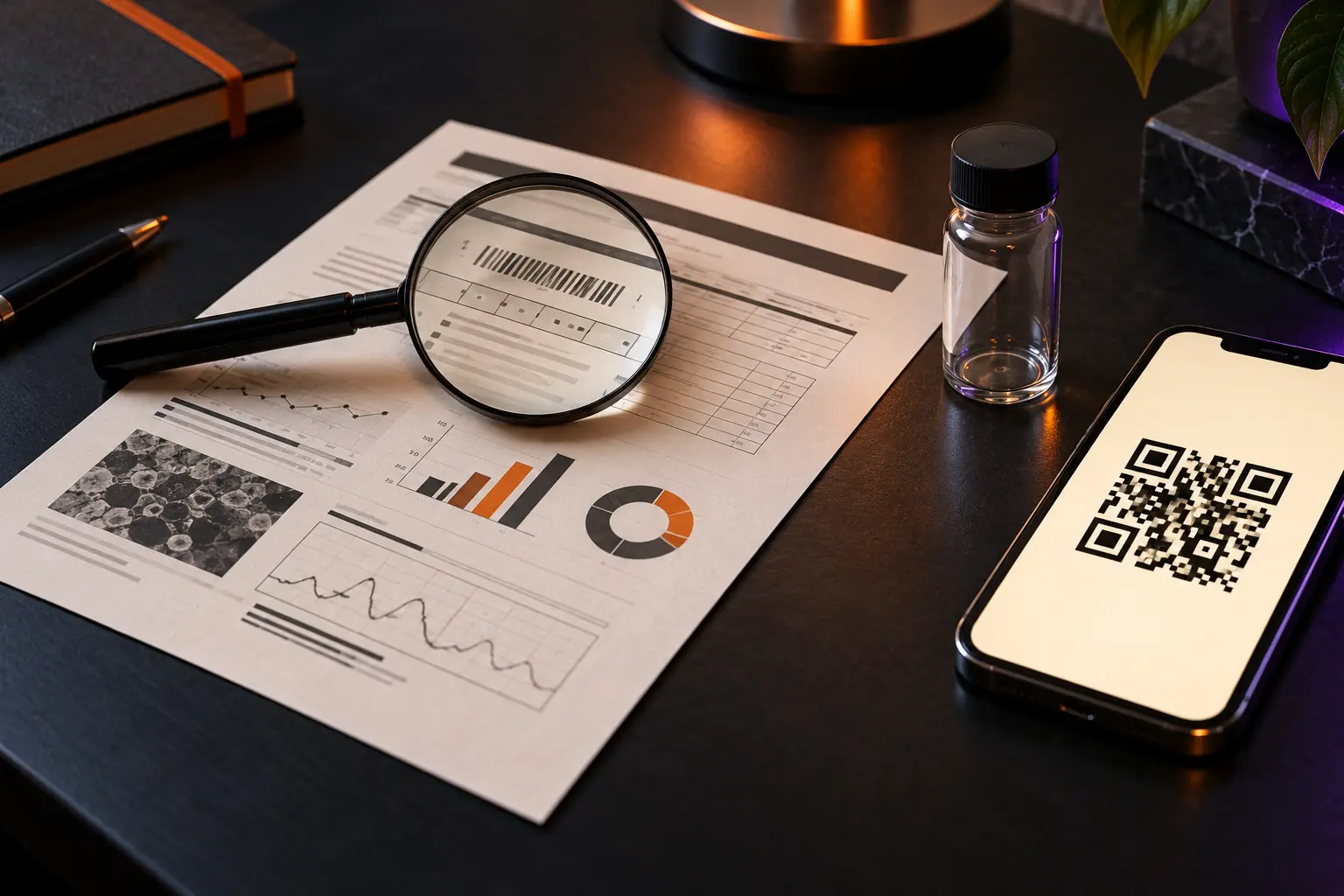
A PDF is a document—not a verdict
A QR code that opens a laboratory report can be useful, but the words “third-party tested” do not explain what was tested, which sample was submitted or whether the report matches the item in front of you. The useful evidence is inside the document.
Start with the basics: the laboratory name, the client that submitted the sample, the sample description, a report or sample ID, dates, methods and results. A polished badge on a package is marketing. A report should provide enough detail to connect a result to one identifiable sample.
Match the product and batch
Look for the product name, batch or lot number, sample ID and any size or form description. Small differences matter: two versions of a similarly named product can have different formulas, production dates or test panels.
Then compare the dates. A report may show when the sample was received, when testing began, when testing ended and when the report was issued. Those dates are not interchangeable. An old report is not automatically false, but it may describe an earlier batch. A missing batch number makes the connection harder to verify.
Check what the laboratory actually tested
“Lab tested” is not a universal panel. One report might measure identity or concentration. Another might cover a set of contaminants. A third might address only one narrow question. Do not assume that a passing result in one section means unlisted categories were also examined.
Find the analyte or test list and the method used. The sample type—or matrix—also matters because a method suitable for one kind of material may not perform the same way with another. FDA’s analytical-procedure guidance describes validation in terms that include accuracy, precision, specificity, range and lower measurement limits. The exact requirements depend on the method and its intended purpose. [3]
Read the units before comparing numbers
A result is incomplete without its unit and basis. Percent, milligrams per gram, milligrams per milliliter and milligrams per package describe different relationships. Two numbers that look similar may not be directly comparable if the units, serving basis or sample preparation differ.
Also look for the limit of detection (LOD or DL) and the limit of quantitation (LOQ or QL). FDA describes a detection limit as the lowest level that can be detected, while a quantitation limit is the lowest level that can be measured quantitatively with suitable performance. [3]
That is why ND or “not detected” should not automatically be read as absolute zero. EPA explains that nondetect results are below a stated detection limit; the actual amount can lie somewhere between zero and that limit. EPA also notes that detection and quantitation limits vary with the parameter, method and laboratory. [4]
Accreditation has a scope
ISO/IEC 17025 is an international standard for the competence, impartiality and consistent operation of testing and calibration laboratories. Accreditation to that standard can support confidence in a laboratory’s work, but it is not a blanket statement that every test the laboratory offers falls within its accredited scope. [1]
ILAC explains that accreditation certificates include a laboratory’s scope and that accreditation bodies maintain directories of accredited facilities. Its guidance says the accreditation body can confirm both a laboratory’s current status and its scope. In other words, check the directory and the specific test area—not only a logo printed on the report. [2]
Do not skip flags, comments or revisions
A result table may include symbols, letters, footnotes or comments. These can mark an estimated value, a result below the quantitation limit, a method deviation, a revised report or another limitation. The meaning is laboratory-specific, so find the report’s own legend rather than guessing.
Check whether the report is marked final, amended or superseded. If a result looks surprising, the responsible question is not simply “pass or fail?” It is “what method, limit, qualifier and decision rule produced that conclusion?” A certificate should not be edited, cropped or separated from the pages that define its notes.
Treat the QR code as a link
A QR code is only a shortcut to a web address. Before opening it, preview the destination when your phone allows it and check the domain for misspellings or substitutions. The Federal Trade Commission warns that malicious QR codes can lead to spoofed sites or install malware. If a code seems suspicious, reach the laboratory or company through a web address you already trust instead of the code itself. [5]
A 60-second lab-report checklist
- Identity: laboratory, client and sample are named.
- Match: product and batch identifiers agree.
- Dates: received, tested and issued dates make sense.
- Scope: the panel lists what was—and was not—tested.
- Method: test method and sample type are identified.
- Units: every result has a clear basis.
- Limits: LOD/LOQ and ND are interpreted correctly.
- Quality: qualifiers, revisions and accreditation scope are checked.
A laboratory report can add real information, but only when the right report is connected to the right sample and read with its limits intact. “Third-party tested” is the beginning of the question—not the answer.
Sources & editorial notes
Reviewed October 23, 2026. This is a general consumer-literacy guide, not a legal conclusion or a determination that any particular product or laboratory is compliant. Pluto’s did not independently audit a laboratory for this article.
- ISO: ISO/IEC 17025 — testing and calibration laboratories
- ILAC: accredited conformity assessment bodies, certificates and reports
- FDA: Q2(R2) Validation of Analytical Procedures, March 2024
- U.S. EPA: Data Considerations — detection limits, quantitation limits and qualifiers
- FTC Consumer Advice: QR-code safety alert, September 3, 2026